
Self Managed vs Plan Managed vs NDIA Managed
Understanding your three options for managing NDIS funding

Learn the differences between self-managed, plan-managed and agency-managed NDIS funding so you can choose the option that best suits your needs.
One of the first decisions you’ll make after receiving an NDIS plan is how you want your funding managed.
At first, the terminology can feel confusing.
Self managed. Plan managed. NDIA managed.
Many participants hear these terms during their planning meeting but aren’t entirely sure what they mean or how they affect everyday life.
The good news is that the choice is often simpler than it sounds.
At its core, plan management is about deciding who handles the financial side of your NDIS funding and how much control you would like over the process.
What Does Managing Your NDIS Plan Mean?
When people talk about managing an NDIS plan, they are talking about three main things:
- Who pays your providers
- Who keeps track of your budget
- How much control you have over your funding
The option you choose can affect the providers you can use, how much paperwork is involved and how much flexibility you have when arranging supports.
The Three Management Options
The NDIS offers three ways to manage funding:
- Self managed
- Plan managed
- NDIA managed
Each option has advantages and disadvantages, and the right choice depends on your individual circumstances.
Quick Comparison
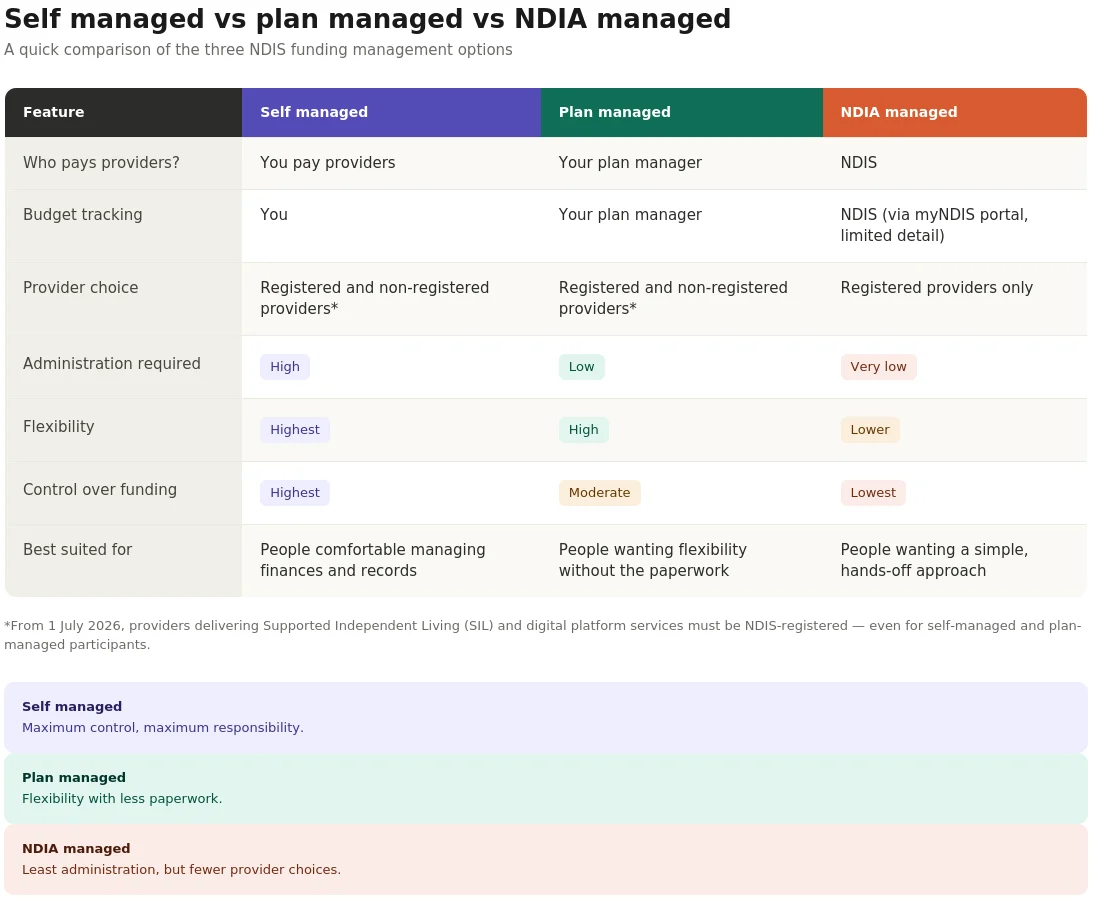
As you can see, the main differences come down to control, flexibility and how much administration you want to manage yourself.
Self Managed
Self management gives you the greatest level of control over your NDIS funding.
If you choose this option, you are responsible for managing payments yourself. In most cases, this means paying providers and then claiming funds back through the myNDIS participant portal, though exact arrangements can vary depending on what you agree with each provider. Either way, you’ll be responsible for keeping records, monitoring your budget and managing payments.
For some participants, this level of control is a major benefit. You can generally choose from both registered and non-registered providers, giving you greater flexibility when arranging supports.
One exception: from 1 July 2026, providers delivering Supported Independent Living (SIL) supports or operating as NDIS digital platforms must be registered, regardless of how your plan is managed.
Self management may suit people who are comfortable managing budgets, keeping records and handling administrative tasks. It can also be a good option for participants who want maximum choice over who provides their supports.
However, with greater control comes greater responsibility. You’ll need to stay on top of invoices, monitor your spending and maintain accurate records.
Plan Managed
Plan management sits in the middle.
Many participants choose this option because it offers flexibility without the administrative workload that comes with self management.
With plan management, an NDIS-funded plan manager handles the financial side of your plan. They pay invoices, keep track of spending and provide reports to help you understand your budget.
You still have the flexibility to choose both registered and non-registered providers, but you don’t need to manage payments yourself.
One important point that many participants don’t realise is that plan management funding is provided separately by the NDIS, under a support category called Improved Life Choices. It does not reduce the funding available for your other supports — it’s an additional amount added to your plan, not taken from your Core or Capital budgets.
For many people, plan management provides a balance between choice, flexibility and convenience.
NDIA Managed
NDIA management is the most hands-off option.
Under this arrangement, the NDIS manages payments directly on your behalf.
This means you don’t need to process invoices or keep track of provider payments yourself. You can still check your remaining budget through the myNDIS participant portal, though the reporting is less detailed than what a plan manager typically provides. The system is straightforward and requires very little administration from participants or their families.
The main trade-off is provider choice.
When your funding is NDIA managed, you can only use providers that are registered with the NDIS. While there are many registered providers available, some participants feel this limits their options compared to self-managed or plan-managed arrangements.
For people who prefer a structured system with minimal administration, NDIA management can be a practical choice.
Can You Use More Than One Option?
In some situations, yes.
Many participants use a combination of management options across different funding categories — this is actually quite common. Different support categories in your plan, such as Core Supports, Capital Supports and Capacity Building, can each be managed differently. For example, Core Supports might be plan managed while another category is self managed.
However, not every support category can be managed freely. Some supports, particularly higher-cost items such as assistive technology or home modifications, may have specific funding and approval requirements.
If you’re unsure what management options apply to your plan, it’s worth discussing them with your Support Coordinator, Local Area Coordinator or NDIS planner.

How Do You Choose the Right Option?
There is no single answer that suits everyone.
Some participants value maximum flexibility and are happy to handle administration themselves.
Others prefer the convenience of having a plan manager assist with payments and budget tracking.
Some simply want a straightforward system where the NDIS handles everything directly.
The best option is the one that matches your confidence, lifestyle and support needs.
Remember, your choice is not necessarily permanent. As your circumstances change, you may be able to discuss different management arrangements during future plan reviews.
Final Thoughts
Understanding how NDIS funding can be managed is an important part of getting the most from your plan.
Whether you choose self management, plan management or NDIA management, the goal is the same: ensuring your funding is used effectively to access the supports that help you achieve your goals.
If you’re unsure which option may be right for you, speaking with an experienced NDIS professional can help you better understand the benefits and responsibilities of each approach.
If you need help understanding your NDIS plan or connecting with suitable supports, the team at JNJ Community can help guide you through your options.
References
- NDIS – Guide to Your Management Options
- NDIS – Self Management
- NDIS Quality and Safeguards Commission – About Registration
- NDIS Pricing Arrangements and Price Limits
Disclaimer
This article is provided for general information only and should not be considered legal, financial, medical or disability support advice. NDIS policies, funding arrangements and participant circumstances may change over time. Please refer to official NDIS resources or seek professional advice regarding your individual situation.