
Home Care Packages vs NDIS: What is the Difference?
Understanding the key differences between the NDIS and Support at Home, including eligibility, funding and the types of support available.

Many people get confused by the difference between the NDIS and aged care support.
It’s understandable.
Both programs are government funded. Both help people receive support while living at home. Both involve assessments, funding and service providers.
However, they are designed for different groups of people and serve different purposes.
If you’re trying to work out which system may apply to you or a loved one, here’s a simple explanation.
The Simple Difference
The easiest way to understand it is this:
The NDIS provides support for people living with a permanent and significant disability.
Support at Home provides support for older Australians who need assistance to continue living independently at home.
While there can be some overlap in the services provided, the two programs are designed for different stages of life and different support needs.
Quick Comparison
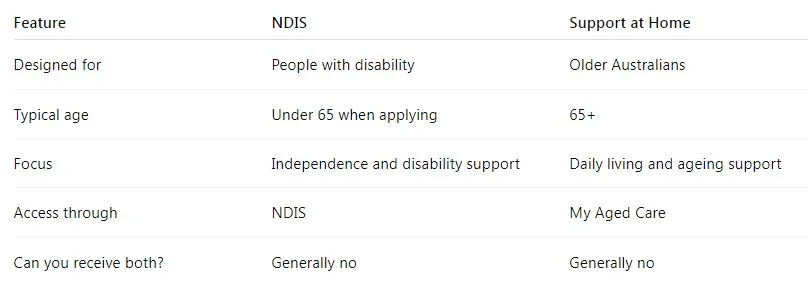
What Is the NDIS?
The National Disability Insurance Scheme (NDIS) helps Australians with a permanent and significant disability access the supports they need to live more independently.
The focus is not simply on providing care. The NDIS aims to help people build skills, improve daily living and participate more fully in their communities.
Depending on an individual’s circumstances, NDIS funding may be used for services and supports such as:
- Support workers
- Occupational therapy
- Physiotherapy
- Speech therapy
- Assistive technology
- Community participation programs
- Skill-building supports
What Is Support at Home?
Support at Home is the Australian Government’s aged care program that replaced the previous Home Care Package system in November 2025.
Its purpose is to help older Australians remain living safely and comfortably in their own homes for as long as possible.
Rather than focusing on disability-related goals, Support at Home focuses on maintaining independence, wellbeing and quality of life.
Support may include assistance with:
- Household cleaning
- Meal preparation
- Personal care
- Transport to appointments
- Home maintenance
- Other everyday tasks
Funding is based on an assessment of an individual’s care needs.
Who Is Eligible?
This is often where people become unsure about which system applies to them.
NDIS Eligibility
You may be eligible for the NDIS if:
- You are under 65 years of age when you apply
- You have a permanent and significant disability
- Your disability affects your ability to carry out everyday activities
An important point to remember is that people who join the NDIS before turning 65 can generally choose to remain on the NDIS after they reach that age.
Support at Home Eligibility
You may be eligible for Support at Home if:
- You are aged 65 years or older
- You require assistance with everyday living activities
- You complete an assessment through My Aged Care
For Aboriginal and Torres Strait Islander people, eligibility may begin from age 50.

What Types of Support Are Available?
While both programs can provide practical assistance, their goals are different.
The NDIS focuses on helping people manage the impacts of disability and improve their independence over time.
Support at Home focuses on helping older Australians remain safe, comfortable and supported while continuing to live at home.
For example, someone receiving NDIS funding may access therapy services, specialised equipment and skill-building supports.
Someone receiving Support at Home funding may receive help with cleaning, personal care, meal preparation and transport.
Both programs can make a significant difference to a person’s quality of life, but they are designed to address different needs.
What Isn’t Covered?
Many people assume government-funded support programs cover all living expenses, but that isn’t the case.
The NDIS does not generally cover:
- Rent or mortgage payments
- Groceries and food
- Utility bills
- Medical treatment
- Costs unrelated to a person’s disability
Support at Home also does not cover:
- Rent or mortgage payments
- General household expenses
- Costs unrelated to assessed care needs
These programs are designed to provide support services rather than replace normal day-to-day living costs.
Can You Receive Both?
In most cases, no.
A person cannot receive both NDIS funding and aged care funding at the same time.
If you joined the NDIS before turning 65, you can usually choose to remain on the NDIS.
Alternatively, you may choose to move into the aged care system if that better suits your circumstances.
Choosing the Right Path?
This is one of the most common questions people ask.
The truth is that neither program is better than the other.
They simply serve different purposes.
The right program depends on your age, your circumstances, your support needs and your personal goals.
Understanding which system applies to your situation is the first step towards accessing the support available to you.
Final Thoughts
The NDIS and Support at Home both play an important role in helping Australians live independently and maintain their quality of life.
While the programs may appear similar at first, they are designed for different groups of people and operate in different ways.
If you’re unsure which pathway applies to you or a family member, taking the time to understand the eligibility requirements and available supports can help you make informed decisions about the future.
If you’re unsure which support pathway may apply to you or a loved one, seeking advice early can help you understand your options and access the support you need sooner.
The team at JNJ Community Support Services can assist NDIS participants and families to better understand available supports and services. Contact us for further assistance today.
For the latest eligibility requirements and program information, refer to the official resources below.
References
- NDIS Quarterly Reports
- NDIS Eligibility Requirements
- Support at Home Program — Australian Government Department of Health and Aged Care
- My Aged Care
Disclaimer
This article is provided for general information only and should not be considered legal, financial, medical, aged care or disability support advice. Eligibility requirements, funding arrangements and government programs may change over time. Please refer to the relevant government websites or seek professional advice regarding your individual circumstances.