
Aged Care Fees Explained Simply: What You Might Pay and Why
A practical guide to the costs of support at home, residential care and respite—and what affects the amount you pay

If you are arranging aged care for yourself or someone close to you, the fee system can be difficult to untangle. There is no single “aged care fee”. Different programs have different charges, and unfamiliar terms such as means-tested contributions and accommodation payments can make a stressful decision feel even harder.
The main thing to know is that the Australian Government subsidises approved aged care, but you may be asked to contribute towards some of the cost. What you pay depends on the type of care you receive, the services you use, your income and assets and, in some cases, when you were approved for or first entered care.
Your aged care assessment through My Aged Care is free. Fees generally become relevant after you are approved and begin arranging services with a provider.
Why Do Aged Care Fees Vary?
Two people receiving similar support may still pay very different amounts. The cost depends partly on whether the person receives entry-level help, ongoing support at home, respite or permanent residential care. It can also be affected by the type and amount of support used, the person’s income and assets, provider prices, the aged care home’s room price and whether older fee protections apply.
An online example can help you understand how the system works, but it cannot tell you exactly what your own fees will be.
What Might You Pay for Help at Home?
Commonwealth Home Support Program
The Commonwealth Home Support Program (CHSP) provides entry-level help for older people who need some assistance to continue living independently at home.
If you receive CHSP services, your provider will usually ask you to contribute towards the cost. Each provider sets its own fees, so prices can vary. You will not be asked to pay the full cost of a government-subsidised CHSP service. Your provider must explain your contribution before services begin and include it in your service agreement.
If the contribution is more than you can afford, tell the provider. CHSP providers must have arrangements for people experiencing financial difficulty.
Support at Home
Support at Home is for people who need more coordinated or ongoing assistance. There is no single flat fee. Instead, a contribution percentage is applied to each service you use, and the government pays the remaining portion of the service price from your available Support at Home funding.
The standard contribution arrangements generally apply if you were approved for a Home Care Package or Support at Home after 12 September 2024:
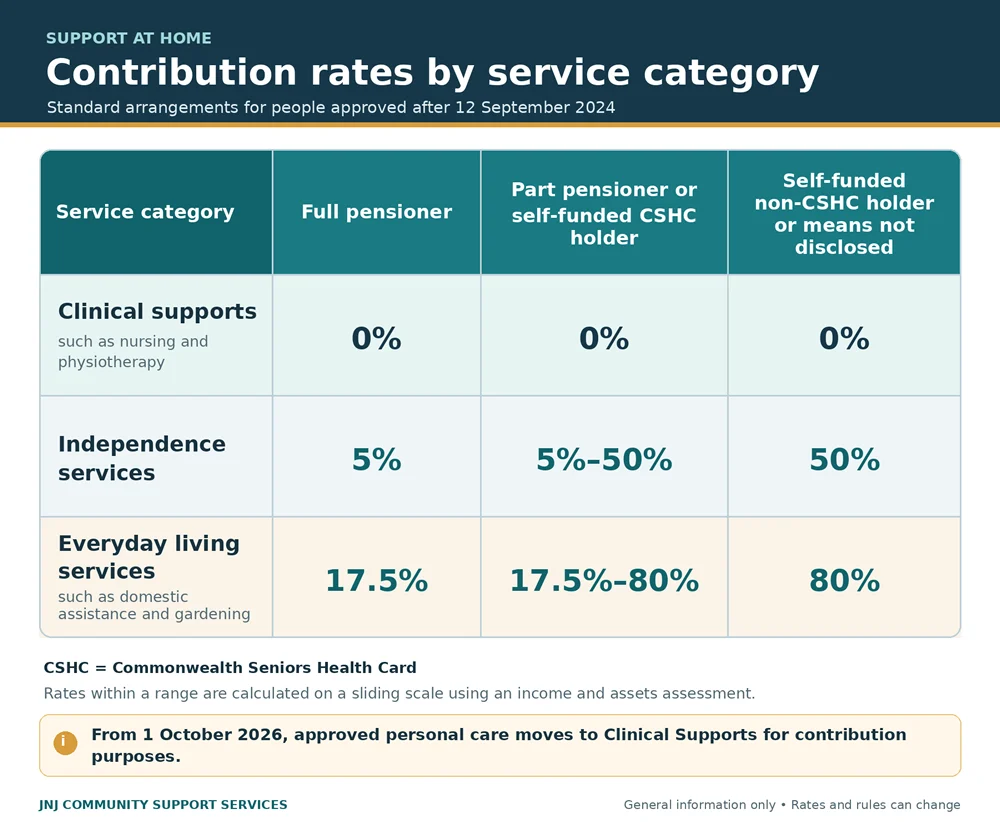
CSHC means Commonwealth Seniors Health Card.
For example, if an everyday living service costs $80 and your contribution rate is 17.5%, you pay $14 and the government-funded portion is $66.
If a range appears in the table, your exact percentage is worked out on a sliding scale using an income and assets assessment. If you do not provide the financial information Services Australia needs, you may be charged the maximum contribution rate.
Until 30 September 2026, personal care sits within the Independence services category. From 1 October 2026, approved personal care services will move to the Clinical Supports category for contribution purposes. This means participants will no longer pay a contribution for approved help with tasks such as showering, dressing, eating, personal hygiene and non-clinical continence management.
Personal care must still be included in the person’s support plan, and the cost will still come from their available Support at Home budget.
What Does “No Worse Off” Mean?
If you were receiving or approved for a Home Care Package on or before 12 September 2024, you are protected by the no worse off principle.
Put simply, if you were assessed as not having to pay an income-tested care fee under your Home Care Package, you will not be asked to pay Support at Home contributions. If you were assessed as having to pay the fee, your Support at Home contributions should be the same or lower.
What Might You Pay in an Aged Care Home?
An aged care home’s quote or invoice can include several different charges. It is easier to understand once you separate the cost of daily living and care from the cost of the room.

Most people who first enter permanent residential care on or after 1 November 2025 are covered by the new fee arrangements. However, people protected by the no worse off principle generally stay under the 1 July 2014 fee arrangements unless they choose to move to the newer arrangements.
There is one extra wrinkle: the rules used for your care fees may be different from the rules used for your accommodation. For example, a person may keep the older fee arrangements but come under the newer accommodation arrangements when they enter an aged care home.
This distinction affects whether deductions such as RAD or RAC retention apply. Services Australia and the aged care home should tell you which arrangements cover you.
The Basic Daily Fee
Every permanent resident pays a basic daily fee. This helps cover meals, cleaning, laundry, utilities and other everyday living costs.
The current maximum basic daily fee is $66.80 per day. This rate took effect on 20 March 2026. It is indexed on 20 March and 20 September each year, so it will change over time.
Means-Tested Contributions
Not everyone pays these contributions.
Under the 1 November 2025 fee arrangements, you may be asked to pay a hotelling contribution of up to $22.15 per day. “Hotelling” is the term used for everyday living services in residential aged care, such as meals, cleaning and laundry. The amount you pay depends on your income and assets.
If you are assessed to pay the full hotelling contribution, you may also have to pay a non-clinical care contribution of up to $107.32 per day. This goes towards support such as bathing, mobility assistance and lifestyle activities.
The non-clinical care contribution does not continue indefinitely. It stops once you reach the indexed lifetime cap—currently $137,917.01—or after you have paid it for a total of four years, whichever happens first. The four years do not have to be consecutive.
Support at Home contributions and previous Home Care Package income-tested care fees count towards the dollar lifetime cap. They do not count towards the four-year time limit, which only measures the time spent paying the non-clinical care contribution in residential care.
If the 1 July 2014 fee arrangements apply to you, you may pay a means-tested care fee instead. This includes many people who entered care from 1 July 2014 to 31 October 2025, as well as people protected by the no worse off principle who enter later.
The means-tested care fee currently has an annual cap of $35,910.43 and a lifetime cap of $86,185.23. Some people who entered care before 1 July 2014 remain under even older arrangements. Services Australia will tell you which rules apply and how much you may be asked to pay.
Accommodation Costs
Your room is charged separately from your care. Aged care homes publish their room prices, and you agree on the price before moving in. Your means assessment determines whether you pay the full cost or the government helps with some or all of it.
You can generally pay by:
- a lump sum, called a Refundable Accommodation Deposit or Contribution (RAD or RAC)
- a non-refundable daily payment, called a Daily Accommodation Payment or Contribution (DAP or DAC)
- a combination of both.
If you are covered by the 1 November 2025 accommodation arrangements and pay a RAD or RAC, retention generally applies. The provider must calculate and deduct retention daily at a rate of 2% per annum on the remaining balance, for up to five years after the lump sum is first paid. The amounts deducted are not refunded when you leave care.
Choosing between a lump sum and daily payments can affect your cash flow, aged care fees and pension entitlements. It is worth getting independent financial advice before paying a large deposit or selling the family home.
Optional Extras
An aged care home may offer higher everyday living services for an extra fee. These services are optional: you cannot be required to buy them as a condition of moving in, and the home cannot ask you to agree to them until after you have moved in.
Before signing, check exactly what will be provided, how often and at what cost. A 28-day cooling-off period applies.
What About Respite and Short-Term Care?
Residential respite has simpler fee rules than permanent care. You will generally pay the basic daily fee—currently up to $66.80 per day—and the home may also ask for a booking fee.
This booking fee is capped at one week’s respite fees or 25% of the total fee for the stay, whichever is lower, and must be deducted from your daily fees once the stay begins, so you are not paying it twice.
You cannot be charged accommodation costs or means-tested contributions for residential respite.
For transition care after a hospital stay, the current maximum is $13.75 per day when care is delivered at home or in the community, or $66.80 per day in a residential setting. Access to transition care cannot be refused because you cannot afford the fee.

How Can You Find Out Your Actual Aged Care Fees?
Online examples are useful, but your actual fees will come from your own assessment and the prices charged by your chosen provider.
Before services begin:
- Apply for a free aged care assessment through My Aged Care.
- Complete the relevant income and assets assessment with Services Australia or the Department of Veterans’ Affairs, if one is required for your type of care.
- Use the My Aged Care fee estimators to get an initial idea of likely costs.
- Ask the provider for its prices and your contribution in writing.
- Check whether any service or extra is optional before agreeing to it.
If the fees are more than you can afford for reasons beyond your control, financial hardship assistance may be available. Before deciding to go without care you need, speak with the provider, My Aged Care or Services Australia about your options.
The Bottom Line
Aged care fees become easier to understand when you break them into three questions: What type of care are you receiving? What does the service or room cost? How much have you been assessed as able to contribute?
At JNJ Community Support, we believe fees and service arrangements should be explained clearly before support begins. Ask for the figures in writing, check what is optional and don’t hesitate to ask a provider to explain an unfamiliar charge.
It is your care and your money, and you deserve to understand both.
The residential aged care fee amounts and caps quoted in this article are current under the Department of Health, Disability and Ageing schedule from 1 July 2026. The $66.80 basic daily fee took effect on 20 March 2026. Government rates, caps and thresholds can change over time. The Support at Home personal care contribution change takes effect from 1 October 2026. This article provides general information only and is not personal financial advice.
References
- My Aged Care – How to Get Assessed
- My Aged Care – Commonwealth Home Support Program Costs
- My Aged Care – Support at Home Costs and Contributions
- Department of Health, Disability and Ageing – Personal Care Contribution Change
- My Aged Care – Aged Care Home Costs and Fees
- Department of Health, Disability and Ageing – Schedule of Fees and Charges for Residential Care from 1 July 2026
- Department of Health, Disability and Ageing – Fee and Accommodation Arrangements for Residential Aged Care
- Department of Health, Disability and Ageing – Means-Tested Fees for Residential Aged Care
- My Aged Care – Understanding Aged Care Home Accommodation Costs
- Department of Health, Disability and Ageing – Refundable accommodation deposit and contribution (RAD and RAC) retention
- Department of Health, Disability and Ageing – Higher Everyday Living, Additional and Extra Service Fees
- My Aged Care – Short-Term Care Costs and Fees
Disclaimer
This article is provided for general information only and should not be considered legal, financial or aged care advice. Aged care fees, contribution rates, funding arrangements and eligibility requirements may change over time. Please refer to My Aged Care, Services Australia or the Department of Health, Disability and Ageing, or seek professional advice regarding your individual circumstances.